


HGF
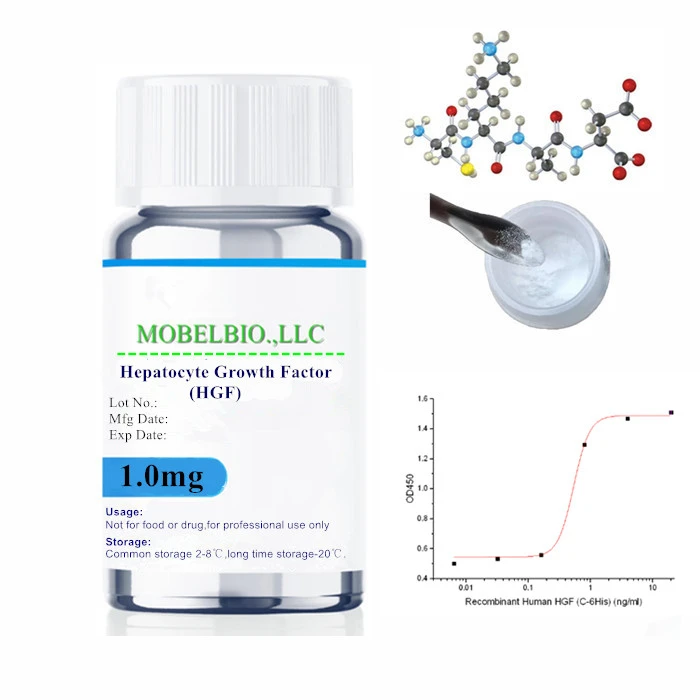
HGF is a potent, mesenchymally-derived mitogen for mature parenchymal hepatocytes, and acts as a growth factor for a broad spectrum of tissues and cell types
Description
Product name: HGF,Hepatocyte Growth Factor
Other Name: HGF; F-TCF; HGFB; HPTA; SF; Scatter Factor; Hepapoietin A; Fibroblast-Derived Tumor Cytotoxic Factor; Lung Fibroblast-Derived Mitogen
Source: CHO-derived Human HGF protein, Gln32-Ser728
Host: E. coli
Endotoxin level: <10.0EU/μg (LAL assay)
Subcellular localization: secretion
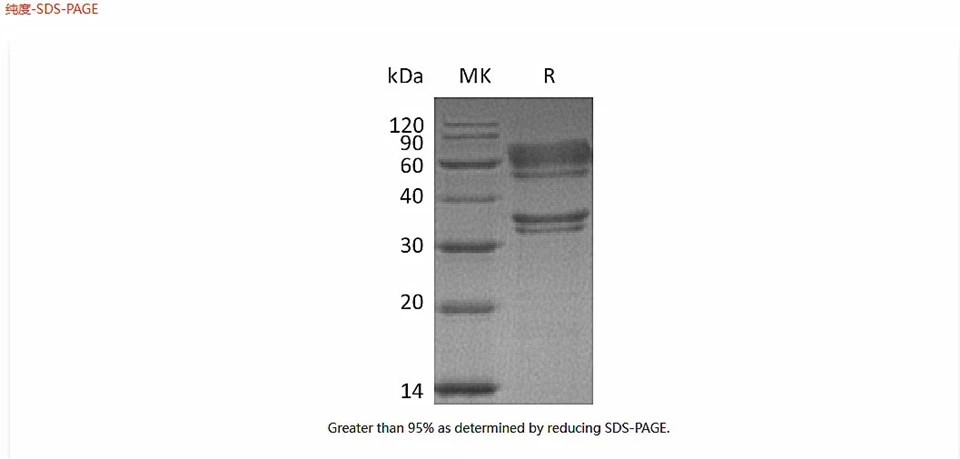
Molecular Weight :88~90 kDa (single chain), 59~61 kDa (alpha chain), 30~34 kDa (beta chain), on SDS-PAGE under reducing conditions.
Purity: > 95% by SDS-PAGE.
Appearance: lyophilized powder
HGF, is a pleiotropic protein in the Plasminogen subfamily of S1 peptidases and contains 4 kringle domains, 1 PAN domain and 1 peptidase S1 domain. HGF is secreted as an inactive 728 amino acid (aa) single chain propeptide. It is cleaved after the fourth Kringle domain by a serine protease to form bioactive disulfide-linked HGF with a 60 kDa alpha and 30 kDa beta chain. HGF binds heparan-sulfate proteoglycans and the widely expressed receptor tyrosine kinase, HGF R/c-MET. HGF regulates epithelial morphogenesis by inducing cell scattering and branching tubulogenesis. It can also alter epithelium morphology by the induction of nectin-1 alpha ectodomain shedding, an adhesion protein component of adherens junctions. HGF regulates cell growth, cell motility, and morphogenesis by activating a tyrosine kinase signaling cascade after binding to the proto oncogenic c-Met receptor. HGF is secreted by mesenchymal cells and acts as a multi-functional cytokine on cells of mainly epithelial origin. Its ability to stimulate mitogenesis, cell motility, and matrix invasion gives it a central role in angiogenesis, tumorogenesis, and tissue regeneration.

Description
HGF is a potent, mesenchymally-derived mitogen for mature parenchymal hepatocytes, and acts as a growth factor for a broad spectrum of tissues and cell types. HGF signals through a transmembrane tyrosine kinase receptor known as MET. Activities of HGF include the induction of cell proliferation, motility, morphogenesis, inhibition of cell growth, and enhancement of neuron survival. HGF is a crucial mitogen for liver regeneration processes, especially after partial hepatectomy and other liver injuries. HGF, also known as scatter factor and hepatopoietin A, is a pleiotropic protein in the plasminogen subfamily of S1 peptidases. It is a multidomain molecule that includes an N-terminal PAN/APPLE‑like domain, four Kringle domains, and a serine proteinase-like domain that has no detectable protease activity. It is cleaved after the fourth Kringle domain by a serine protease to form bioactivedisulfide‑linked HGF with a 60 kDa alpha and 30 kDa beta chain. Alternate splicing generates human HGF isoforms that lack the proteinase‑like domain and different numbers of the Kringle domains. Human HGF shares 91%‑94% aa sequence identity with bovine, canine, feline, mouse, and rat HGF. HGF binds heparan-sulfate proteoglycans and the widely expressed receptor tyrosine kinase, HGF R/c-MET.
The product is for laboratory research only.
Hot Tags: hgf, hgf manufacturers, suppliers, factory, Biotinoyl Tripeptide, Acetyl Hexapeptide 8 In Skin Care, Magnesium Ascorbyl Phosphate, Fish Collagen Powder, Pregabalin Crystal, 98319-26-7
Send Inquiry
You Might Also Like


